Cultural bridges through poetry: Iran honors Korean Poet Yoon Dong-ju
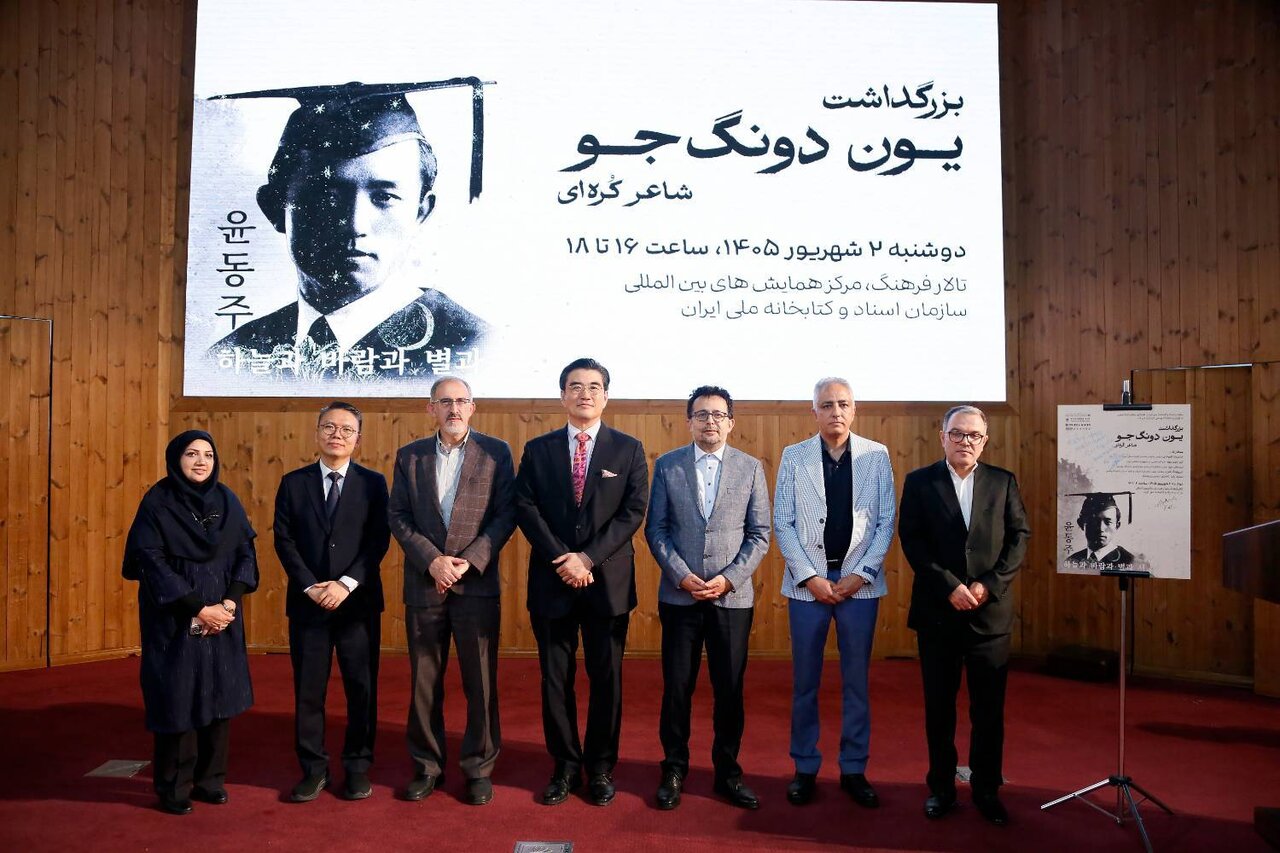
TEHRAN- In a vibrant testament to the power of literature to transcend borders, the National Library and Archives of Iran (NLAI) hosted a commemorative ceremony on Monday, August 24, honoring Yoon Dong-ju, one of Korea's most beloved contemporary poets.
The event, held at the NLAI's Farhang Hall, was organized in collaboration with the Embassy of the Republic of Korea in Tehran and Yonsei University, drawing a distinguished audience of cultural officials, university professors, researchers, and poetry enthusiasts from both nations.
The gathering underscored a fundamental truth: poetry and literature remain among the most enduring mediums for dialogue between nations, offering profound insights into the historical and cultural experiences of diverse peoples. The ceremony featured speeches from Gholamreza Amirkhani, President of the NLAI; Kim Junpyo, Ambassador of Korea to Iran; Joo ILL Sun, Dean of the College of Liberal Arts at Yonsei University; Shin Ji Young, Vice Dean of the same college, and Saeid Reza Ettehadi, Translator and Researcher.
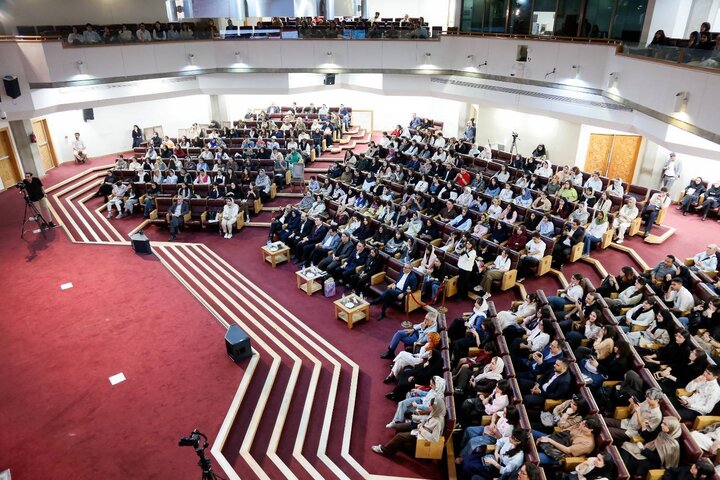
Also the hall for 500 audiences was fully occupied by the BTS.
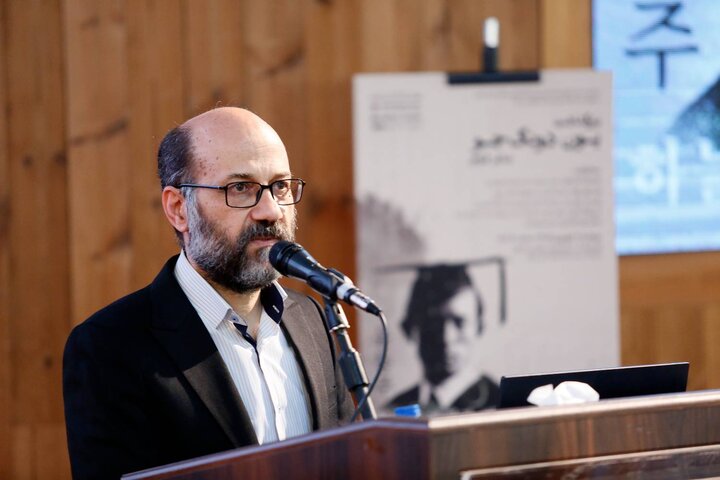
Speaking in the event, Gholamreza Amirkhani, referring to the position of the National Library and Archives Organization of Iran in preserving the country's written heritage, said: "The organization does not only engage in preservation and maintenance; a significant part of its activities is related to cultural diplomacy, and today we are witnessing one of its programs."
Referring to the cultural relations between Iran and Korea, he added: "In the past year or two, activities have increased and we have established very good connections with various countries around the world. Today, too, a program centered on Korea is being held, dedicated to an important and renowned poet of that country."
The head of the National Library and Archives Organization of Iran, referring to the fiftieth anniversary of the establishment of Iranology chairs at Korean universities, said: "To date, nearly 1,500 students from Korean universities have graduated in the field of Iranian studies, and each of these individuals can serve as worthy ambassadors of Iran's history, culture, and civilization in South Korea."
Amirkhani also spoke about library cooperation between the two countries, stating: "We dedicated the first dedicated room and special space to Korea in 2009, which today includes hundreds of books in English, available to researchers in the field of Korean books and bibliography. We hope that interactions between the two countries, centered on the National Library, will expand even further."
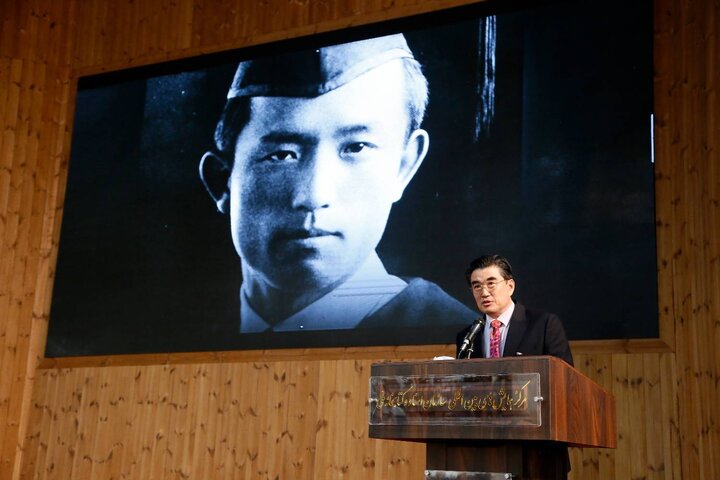
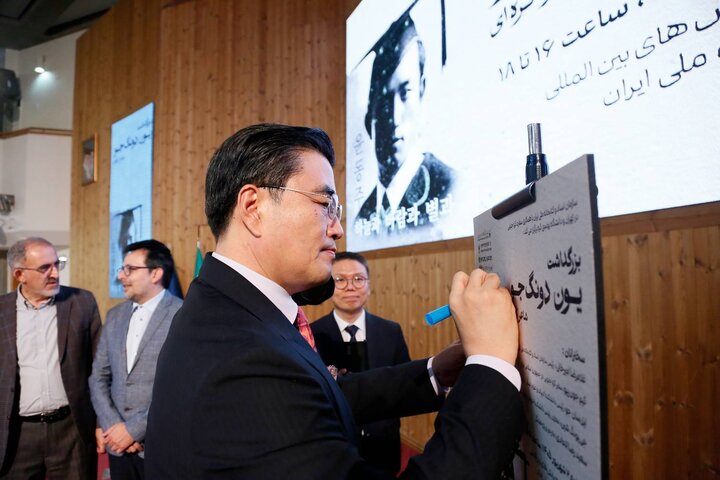
Ambassador Kim also delivered speech, that comes as follows:
Hello everyone.
I greet you all. Welcome.
I am very pleased to be with you today.
I sincerely welcome all of you who have gathered here for the seminar on Yoon Dong-ju—one of the most beloved poets of today's Korea among its people.
And today, when I came here, an impressive scene was imprinted on my mind.
As you all know, you are all familiar with the famous Korean group BTS, aren't you?
But today, when I came here, I felt... as if we too have been placed alongside BTS.
Bridge Between Tehran and Seoul
That bridge is none other than you yourselves.
Yes, exactly—it is you.
Every one of you who is interested in Korean poetry and culture and is present here today is yourself a bridge connecting Tehran and Seoul; you are BTS.
I invite all of you who have attended this program to express your appreciation for one another with a warm round of applause.
I also sincerely thank Dr. Gholamreza Amirkhani, the respected President of the National Library of Iran, and all the organizers of this institution who have stood by us in holding this valuable program.
I also extend my sincere gratitude to Professor Joo ILL Sun, the respected Dean of the College of Liberal Arts at Yonsei University, a senior scholar and alumnus of the university; to Ms. Shin Ji Young, the respected Vice Dean of the College; to the organizers of the Yoon Dong-ju Memorial Museum; and to Mr. Saeid Reza Ettehadi, who has undertaken the presentation of this program.
I kindly ask you all to give them a warm round of applause as well.
During the time I have lived in Iran, I have always felt one thing again and again.
Iran is truly a land that loves books and poetry. In the heart of its thousands of years of history, poetry and literature remain alive and flowing in the everyday lives of its people.
For this reason, I believe that the encounter and connection between Iran and Korea through the medium of books is something very natural.
In 2010, based on cooperation between the national libraries of the two countries, the "Korea Corner" was established here.
After that, thousands of Korean books were donated to this collection, and with the support of Samsung, the "Korea Corner" was developed into a multimedia space as well.
And today, we are taking another step forward.
We have gone beyond simply introducing a book—today, we are speaking with one another about the life and inner world of the person who wrote that book.
And for me, the fact that the first figure on this path is Yoon Dong-ju holds a special meaning. The poet Yoon Dong-ju is also a special figure for me.
He is also one of the senior scholars and alumni of my university, before my time.
Whenever I passed by the memorial stone of Yoon Dong-ju on campus during my student days, I felt that his spirit and ideals, engraved on that stone, were also being engraved in my heart.
"Until the day I die, I keep my eyes toward the sky and let not even a speck of shame exist within you."
That single verse, in my youth, became the compass of my life—that I must give my utmost effort in the life entrusted to me, and live with love and kindness alongside those around me.
So that I do not forget that feeling and belief from those days, even after becoming a diplomat, I carry this poetry collection with me wherever I go.
And after coming to Iran, I became acquainted with great poets such as Hafez and other magnificent Iranian poets. If Yoon Dong-ju's poetry in Korea made me reflect on how to live, Iranian poetry taught me how to look at life with a deeper and broader perspective.
And in Iran, I came to know not only poetry, but also the kindness and affection of its people. A mother's love knows no conditions; a mother simply loves.
Here in Iran, too, I have received such unconditional warmth and affection from many people. For this reason, I am deeply grateful to Iran.
If we think about it, good poetry is exactly the same way.
It crosses beyond the boundaries of language and geography, and finds its way from one human heart to another.
Just as Yoon Dong-ju's poetry moves the hearts of the Korean people, and Hafez's poetry moves the hearts of the Iranian people, today, too, through each other's poetry, we come to know one another's hearts and feelings a little more deeply.
I hope that from today onward, Korean literature and culture will be introduced and recognized even more widely here, and that Iran's beautiful and rich culture will also be better known and introduced in Korea.
Yoon Dong-ju lived in a difficult era, but he left behind his pure conscience and his love for his fellow beings in the form of poetry.
I hope that in these moments today, as we read his poetry together, our hearts will be filled with such love—and that these moments will bring us one step closer to one another, so that the hearts of Iran and Korea may draw nearer.
And I hope that you, who are present here today, will continue from now on as well to be the bridge of connection between Tehran and Seoul—our BTS.
Long live the friendship of Iran and Korea!
Thank you very much.

Joo ILL Sun, Dean of the College of Liberal arts at Yonsei University, who then delivered his speech online, referring to the difficult conditions of the Iranian people, said: "The fire of war not only destroys people's homes and lives, but also tramples upon human dignity and peaceful daily life, confronting us with the fundamental question of what it means to be human."
Referring to the challenges of today's world, he added: "Today, humanity lives in the heart of a vast and accelerating civilization driven by artificial intelligence. Algorithms are rapidly replacing human thought, reducing all values to criteria such as efficiency and utility."
The Dean of Yonsei University's College of Humanities, referring to the significance of Yoon Dong-ju's poetry, said: "In such a turbulent and deprived era, Yoon Dong-ju's poetry carries a profound flight beyond time and geographical borders."
He concluded by stating: "In an age when artificial intelligence instantly offers a barrage of ready-made answers, Yoon Dong-ju's poetry, instead of providing the right answer, places the question of conscience before us and calls us to rediscover the depth of a humanity that refuses easy compromise."
Then, Shin Ji Young, Vice Dean of the same college, speaking online about Yoon Dong-ju's place in Korean literature, said: "It can be said that Yoon Dong-ju is one of the most beloved poets, cherished by the Korean people more than any other. One could say that just as Iran has Hafez's poetry, in Korea we have Yoon Dong-ju's poetry."
Referring to the circumstances of the poet's life, she added: "Yoon Dong-ju's life continued under conditions where the sufferings of colonial rule—including the prohibition of using the Korean language, the forced change of Korean names to Japanese names, and the mobilization of students for war—were imposed on the people one after another; nevertheless, he continued to compose simple and beautiful poetry in Korean."
Shin Ji Young explained the characteristics of Korean poetry and the concepts of "Han" and "Heung": "In Korean literature, two important characteristics are observed; one is 'Han,' which is untranslatable but can be understood as the internalization of pain and suffering, and the other is 'Heung,' which represents an effort to maintain a positive outlook and hope in difficult circumstances."
Regarding the preservation of Yoon Dong-ju's works, she said: "How Yoon Dong-ju's poems—written in Korean, a language that was prohibited under colonial rule—managed to reach us holds a beautiful secret: the secret of a beautiful friendship."
The Yonsei University Vice Dean also referred to the connection between Yoon Dong-ju and Mehdi Akhavan-Sales, stating: "Here I feel a deep bond between these two poets—two poets who, even in dark times, through their poetry, sought to preserve their conscience, will, and love for the beings they cherished."
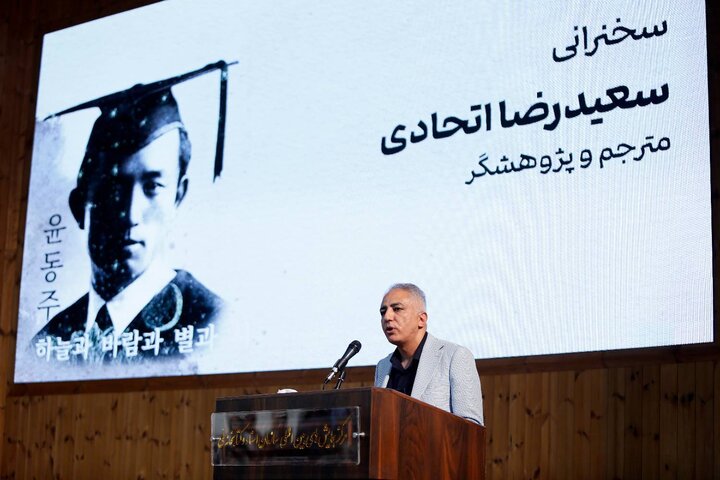
Also, Saeid Reza Ettehadi, Translator and Researcher, speaking about the translation of Yoon Dong-ju's works, said: "The most important thing for me is that these translations have been recognized after about five years, and it has once again reinforced my belief in the power of books and their enduring nature."
Referring to the difficulty of translating Korean poetry, he added: "For an Iranian reader, regardless of the subject, meter and rhyme are important. We tried to remain faithful to the content the poet expressed in our translations, but on the other hand, we did not make the poetry entirely Persianized."
The translator and researcher spoke about his collaboration method with the Korean translator, saying: "With my native Persian and Ms. Hong's native Korean, we tried to convey the content in a way that both maintains fidelity to the poem and makes the translation accessible to the Persian-speaking audience."
Ettehadi, referring to the role of poetry in preserving Korean identity, said: "During the Japanese colonial period, poetry became a tool for resisting colonialism. Just as Iranian poets like Ferdowsi played a role in preserving the Persian language, poets such as Yoon Dong-ju and other Korean poets did not allow the Korean language and culture to perish."
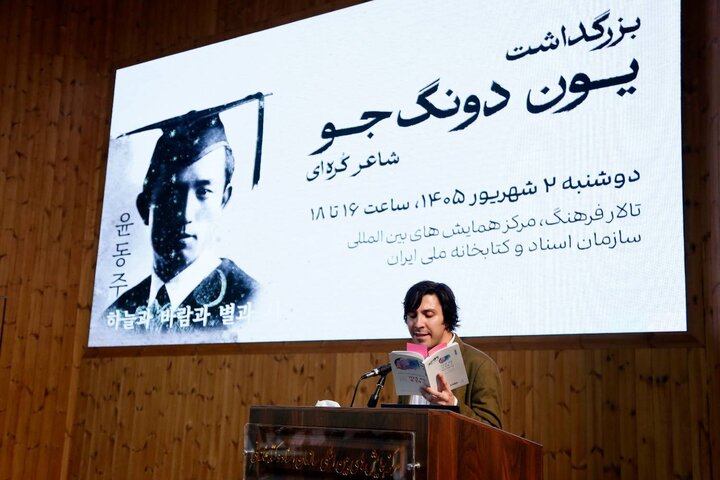
The session concluded with a poetry reading of excerpts from Yoon Dong-ju's works in Persian and English by Amir Khaghani, the session's secretary, and attendees became acquainted with various dimensions of the poet's life, thought, and poetry, as well as the role of his works in preserving the language, cultural identity, and human conscience of the Korean people. The holding of this session also provided an opportunity for cultural dialogue and the strengthening of literary and library ties between Iran and the Republic of Korea.
Born in 1917 in Bukkando, Yoon Dong-ju cultivated his literary talents from a young age, immersing himself in books and poetry despite his parents' concerns about the "impractical" nature of a writing career. He graduated from Yonhui University—now Yonsei University—and later pursued English Literature in Japan during a period of colonial rule. In that challenging environment, Yoon grappled daily with shame and helplessness, emotions that permeate his verse. Yet even without explicit political statements, his decision to continue writing in his native Korean—despite prohibitions—signified a quiet but profound pride in his heritage, leading many today to regard him as a patriot.
His poetry, characterized by a deceptively simple style and rich with Christian imagery reflective of his devout faith, explores themes of personal guilt, longing, and the search for purity in times of oppression. Rather than overt nationalism, Yoon's work offers an introspective and self-critical lens, examining individual responsibility within the context of societal injustice. Though he died young, his lyrical and emotionally powerful poems have been translated into numerous languages and continue to resonate globally, finding echoes in the works of poets like Pablo Neruda and Nazim Hikmet who wrote under oppressive regimes.
The event also served as a powerful reminder of the deepening cultural ties between Iran and South Korea. Ambassador Kim Junpyo, who has been notably active in fostering cultural diplomacy during his tenure in Tehran, has consistently championed events that introduce Korean heritage to Iranian audiences. Under his leadership, the Embassy has organized numerous cultural programs—from film screenings and calligraphy exhibitions to literary seminars—reinforcing the belief that shared appreciation for art and history can build lasting bridges between peoples.
The commemoration of Yoon Dong-ju, enriched by the presence of scholars from Yonsei University, provided a unique platform for Iranian and Korean intellectuals to engage in meaningful exchange. It highlighted how the exploration of a poet's legacy can illuminate universal human experiences, while simultaneously celebrating the distinct cultural identities that make such exchanges so valuable. As both nations continue to expand their diplomatic and economic partnerships, events like this ensure that cultural understanding remains at the heart of their relationship, proving that the language of poetry is one spoken and cherished by all.
Leave a Comment